
Curriculum links
WA HPE Curriculum
Sub-strand: Staying safe
- Protective behaviours and help-seeking strategies to keep safe
- Strategies to use when help is needed.
Sub-strand: Communicating and interacting for health and wellbeing
- Positive ways to react to their own emotions in different situations.
International technical guidance of sexuality education
Key concept 1.1 (5-8 years)
- There are many different kinds of families that exist around the world.
- Family members have different needs and roles.
Key concept 1.4 (5-8 years)
- There are different family structures and concepts of marriage.
Key concept 5.5 (5-8 years)
- Friends, family, teachers, religious leaders and community members can and should help each other.
Materials
- Lion King DVD [89mins] or similar. The 1994 film has a G rating, with 2024 film PG. Please check for a G rated film.
Similar films: Finding Nemo, Lilo & Stitch, The Rugrats Movie, The Land Before Time, Babe. - Large piece of butcher's paper
- Student Activity Sheet: If I were Simba [one per student]
- Student Activity Sheet: I can cope [one per student]
Before you get started
- The following activities are an introduction to changes that occur in the family structure including birth and death, as well as ways of coping with change.
- It is recommended that the teacher only use these activities once they have an understanding of each student’s family life and current situation.
- Similarly themed stories can be used to illustrate changes within the family. See recommended films in the materials section.
- Teachers should know and understand the protective interrupting technique and what, why, when and how it is needed and used.
Learning activities
Whole class
40 min
This activity develops students' understanding of positive and negative change and feelings associated with those changes. Specifically, it looks at changes that occur in the family structure, including birth and death, as well as introducing ways of coping with change.
- As a class, use the brainstorm teaching strategy to identify changes that may occur within a family, looking at both positives and negatives, and how it could make students feel, e.g. ideas may include the death of a pet, birth of a baby brother or sister, separation of their family, etc. Write responses on a large sheet of butcher's paper.
- Read or watch The Lion King or alternative story. (Note: students can watch over a series of 3 or 4 lessons).
- Either complete the story or stop at intervals to discuss the feelings associated with the changes in the family structure from the perspective of the chosen characters.
- Examine and discuss the effect of changes in the family in the chosen story. Identify which changes might be viewed as positive or negative.
- Chart the class findings in a Cause and Effect diagram. For example:
| Cause | Effect |
|---|---|
| Birth of Simba | Parents happy, kingdom celebrates, Scar is jealous |
- Discuss the ways the family coped with change in the chosen story, e.g. "How did Simba cope with the death of his father?". Was this a good way of coping?
Note: The concept of 'coping' may need further explanation, and specific examples may need to be provided. See below.
Coping: things that people do to help themselves deal with problems and manage uncomfortable emotions.
Examples: hugging a teddy or pillow when feeling sad, going for a walk outside when feeling worried. These are small things that might make someone feel better.
Independent or small group
10 min
Students identify specific strategies to cope with changes in their own family.
- Encourage students to consider what might have been other and/or more effective ways of coping to the strategies used by the characters in the chosen story.
- Use an explosion chart or mind map strategy to record student ideas.
- If the story of the Lion King was used in the Whole Class activity, students can individually complete the Student Activity Sheet: If I were Simba.
- To build up a bank of ideas for coping with change, students complete the Student Activity Sheet: I can cope.
- Have students describe or draw about what they have discovered about helpful ways of coping with change (e.g. talk to a friend, parent, sibling, teacher, have a cry, hug or talk to your pet). Other examples and prompts may include hugging or playing with a favourite toy, watching a funny movie or television show, colouring in and spending time outside.
3-2-1 Reflection
10 min
Choose some of the following questions to discuss and/or write responses to.
- What is a family?
- Where can we find families?
- Do families always have to live in the one place together or do some families live in different houses/towns/countries?
- Do we find out different information about other families from TV shows and ads? If so, what?
- Do the families you see on TV shows or ads mostly live in the one house together, and mostly have a Mum, a Dad and some children?
- How do you think people might feel if their own families weren't like the ones on TV or ads? Why?
- What could the people who make TV shows and ads do to change this?
- Why do we live in families?
- When might change occur in a family?
- How do people cope with changes in their family?
- What would you do to cope with a change in your family such as....?
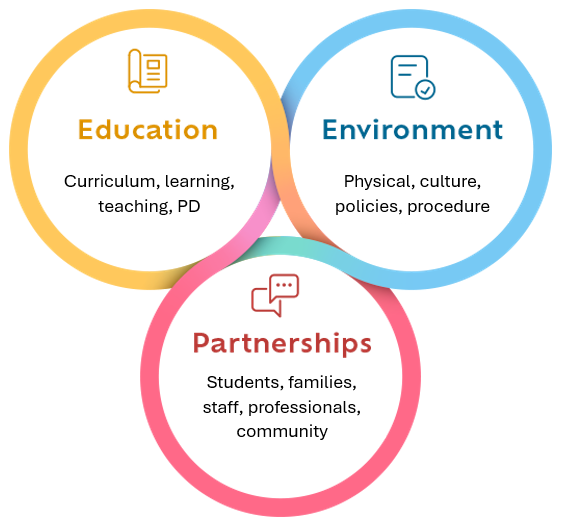
Health promoting schools
Background teacher note: Health promoting schools framework.
Partnerships
Family
- Talk Soon. Talk Often: a guide for parents talking to their kids about sex is a free hardcopy resource that can be bulk ordered by schools and website. Send a copy home to parents prior to starting your RSE program. The booklet offers ages and stage related information on puberty (and other topics) so that parents can reinforce the topics covered in class. (How to order hard copies.) Provide the link to parents on school websites and social media.
- Run a parent and child evening session, where the children can teach the parents what they have been learning about.