
Learning objective
Students discuss the changes that take place in families and identify realistic independent activities that they can do to help and cope with these changes.
Take home messages
Curriculum links
Personal identity and change
- The body’s reactions to emotions, and strategies to help manage these reactions
Interacting with others
- Ways to interpret the feelings of others in different situations to help develop respectful relationships as individuals grow older
International technical guidance of sexuality education
Key concept 1.1 Families (5-8 years)
- There are many different kinds of families that exist around the world
- Family members have different needs and roles
Key concept 1.4 Long term commitments and parenting (5-8 years)
- There are different family structures and concepts of marriage.
Key concept 5.5 Finding help and support (5-8 years)
- Friends, family, teachers, religious leaders and community members can and should help each other.
Materials
Before you get started
- Be mindful that discussing significant changes in the family's routine, structure or dynamic might bring up challenging feelings for students (e.g. separation or divorce; or death of a parent, grandparent or pet). This activity focuses on babies as a way of discussing change in a family, however some students may not have younger siblings so other topics relating to change may need to be used as the stimulus for discussion.
- It is important for the teacher to consider and affirm a range of family contexts, parent/carer dynamics and cultural backgrounds that students may describe, to ensure the traditional family structure is not held up as the 'norm', or the only or best way.
- Teachers should know and understand the protective interrupting technique, and what, why, when and how it is needed and used, before facilitating this activity.
Learning activities
Whole class
30 mins
This activity uses the picture book Changes by Anthony Browne (or an alternative text) as the starting point to reinforce the changes that occur in families.
- Set the scene: Highlight to students that we were all babies once, but have grown and developed and can now do things that we couldn't do when we were younger.
- Use a shared reading strategy to guide this activity. Provide students with a short period of time to preview the book Changes silently as a group.
- Ask students to share their predictions of the main ideas with a partner. Select a few students to share their predictions. Ask:
- What do you think the story will be about?
- How do you know and why do you think this?
- Can you think of any good changes that have happened in your family? (Introduction of a pet or new sibling, a marriage or new relationship with parents and older siblings)
- How have you felt when these changes have happened?
- Can you think of any not so good changes that have happened in your family? (An argument, loss of a pet or loved one, a separation or relationship breakdown)
- How have you felt when these changes have happened?
- Read the story to the class. The following focus questions may be used as a prompt to assist students to think about the story:
- What are some of the differences we notice between babies, toddlers, young people, teenagers or adults like our parents? (size, independence, thinking, what they can do, how they speak)
- Where do we get this information about what babies can do and what children your age can do? (our own families; friend's families; watching families on TV, in ads, in magazines; at the movies)
- Do we sometimes see children your age on TV or in ads or in movies doing physical things that you can't do? What things? (e.g. super powers) Can you believe these things you see in the media all the time?
- In the context of the story Changes, discuss the needs of a baby and how he/she can impact on other family members. If another text is chosen, discuss the family changes that occur during the story and how this impacts other family members.
- Babies' needs might include food (milk that sometimes comes from mothers' breastfeeding, sometimes from a bottle), play and someone looking out for them (they can't be left alone or unsupervised, etc).
- Incorporate ideas about how their own needs, as well as those of others, may also change, causing a shift in the dynamics of the family (e.g. the attention they once had from their parents may have shifted to the baby or person in need; they may be expected to be more independent and self-manage certain tasks). Ask:
- How has this made them feel?
- What physical things can babies do?
- What physical things can toddlers do?
- What physical things can you do now?
- What games could you play with babies?
- What games can you play now?
- Discuss how older children can modify their behaviour and habits around the home to support the family in adapting to the baby's arrival. (Helping parents with household jobs and baby routines, looking after or caring for younger siblings, keeping spaces tidy and clean).
Independent or small group
15 min
Students explore and identify activities they are able to do independently to support family change.
- Have students work together in small groups or pairs to compile a list of tasks they have been able to do and manage themselves as they grow older and become more independent.
- This could include self-management related tasks such as: packing their own school bag, putting their clean or dirty clothes away, preparing themselves for bed, brushing their teeth, organising their uniform or equipment for sports practice.
- Have students select a scribe to write down a word to describe, or draw a picture of, each task on strips of paper or post-it notes.
- Create a pin-up board, poster or use blu-tack to display the words somewhere in the classroom for students to share.
3-2-1 Reflection
5 min
- Using suggestions from the students, develop a list of 'feeling' words and emotions that might describe changes that occur in a family. Accept all suggestions, recording words that have both positive and negative connotations (e.g. excited, happy, surprised, disappointed, sad or angry).
- Students could use these as a stimulus to create their own class 'bank of emotions' photo montage or book. Each student could create a face to match a different emotion. Using these as visual reminders would be a great way for students to refer back to as needed in the future.
- An alternative option is to provide a set of the emotions/feelings cards and have students select a card each using the strategy think-pair-share to further explore how facial expressions show how people are feeling and to practise naming emotions.
- Emotions/feelings cards can be downloaded from the site Do2Learn or purchased from Innovative resources.
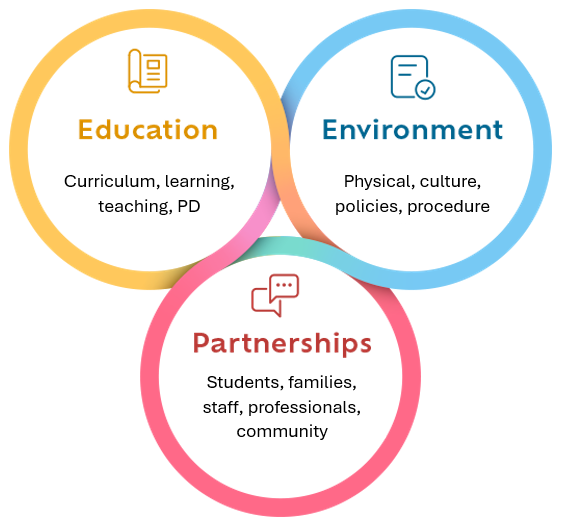
Health promoting schools
Background teacher note: Health promoting schools framework.
Partnerships
Family
- Talk Soon. Talk Often: a guide for parents talking to their kids about sex is a free hardcopy resource that can be bulk ordered by schools and website. Send a copy home to parents prior to starting your RSE program. The booklet offers ages and stage related information on puberty (and other topics) so that parents can reinforce the topics covered in class. (How to order hard copies.) Provide the link to parents on school websites and social media.
Environment
Policies and procedures
- Cater to and include different family dynamics and carers in policies and events where parents and carers engage with the school. Consider the importance of celebrating a variety of significant days (outside of Mother's Day and Father's Day) to include greater opportunities for students and families who may not celebrate these days.