
Curriculum links
WA HPE Curriculum
Sub-strand: Personal identity and change
- Impact of societal and cultural influences on personal identities and health behaviour
Sub-strand: Staying safe
- Analysis of health information and content related to:
- alcohol, drugs or other harmful substances
- body image
- processed food
- road safety
- relationships
Sub-strand: Healthy and active communities
- Health information, support services and media messaging about relationships, lifestyle choices, health decisions and behaviours
- Health promotion designed to raise awareness, influence attitudes, promote healthy behaviours and increase connection to the community
- Social, economic and environmental factors that can influence health
International technical guidance on sexuality education
Key concept 2.3 Culture, Society and Sexuality (15-18+ years)
- Key idea: It is important to be aware of how social and cultural norms impact sexual behaviour while developing one’s own point of view.
Key concept 4.3 Safe Use of Information and Communication Technologies (ICTs)
- Key idea: Social media use can result in many benefits, but also has the potential for moral, ethical and legal situations that require careful navigation.
Key concept 5.4 Media Literacy and Sexuality
- Key idea: Negative and inaccurate media portrayals of men and women can be challenged to influence behaviour positively and promote gender equality.
Key concept 5.5 Finding Help and Support
- Key idea: Everyone has the right to affordable, factual and respectful assistance that maintains confidentiality and protects privacy.
Materials
- Student Activity Sheet: KWL – Health campaigns [one per student]
- Student Activity Sheet: Health campaign case studies [one per pair]
- Teaching Resource: Health campaign topics PowerPoint slides [one per student/group]
- Student Activity Sheet: Health campaign plan [one per student/group]
- Student Activity Sheet: Campaign evaluation [one per student/group]
Before you get started
- This is a recommended 4-6 week unit of work. Students will require access to the internet. Prior to starting the unit, check websites and associated campaigns are accessible on school networks.
- Protective interrupting - Teachers need to know and understand how to use this technique to prevent students from potentially disclosing sensitive information or abuse in front of other students.
- Managing disclosures - Teachers must be aware of school and legal procedures if a student discloses personal issues, particularly disclosures of sexual abuse.
- Teachers need to understand the concept of health promotion to facilitate the delivery of this learning activity.
The World Health Organization defines health promotion as
“…the process of enabling people to increase control over, and to improve, their health”.1
Health promotion interventions include policy development; legislation and regulation; re-orienting health services; community development; creating healthy environments; and raising public awareness and engagement through health campaigns. This learning activity focuses on the impact of health campaigns on changing health behaviours through the use of mass media, social media and/or community events.
1 World Health Organization. Retrieved 16/07/2024
Learning activities
Exploring health campaigns
20 minutes
Students explore their understanding of health campaigns and determine what they need to know in order to develop a health campaign of their own.
- Give each student a copy of the Student Activity Sheet: KWL – Health campaigns. Allow 5 minutes for each student to complete the ‘What I know’ about health campaigns section individually. Discuss student answers as a class.
- Explain to the class what a health campaign is:
A health campaign aims to raise awareness and understanding of a health issue and often aims to change people’s health behaviours. This can be done in a number of ways including mass media, social media and community events.
- Allow 2 minutes for each student to complete the ‘What I want to know’ section of the KWL chart. Discuss student answers as a class.
Note: Students will complete the 'What I have learnt' section at the end of this unit of work so should be encouraged to keep in a place easy to find later.
Campaign case studies
25 minutes
Access to a computer lab and internet will be required for this activity as students will investigate case studies of local and national health campaigns. They will then develop a health campaign of their own on one of five sexual health and/or relationships topics: Growing Bodies; Respectful Relationships; Staying Safe; Emotional Wellbeing and/or Diversity.
- Students form a pair or group of three. Provide each pair/group with one of the case studies from the Student Activity Sheet: Health campaign case studies.
- Ask the students to visit the campaign website and familiarise themselves with the campaign. They then complete the activity sheet by identifying the target group; the positives, negatives and issues of the campaign; and if the campaign worked.
- All students who worked on the same campaign are then joined together in a larger group to discuss their results. Each group then nominates a spokesperson to present their findings to the class.
- Explain to students that they will be developing their own health campaign on a sexual health and/or relationship topic of their choice. This can be done individually, in pairs, or in small groups.
- Display the Teaching Resource: Health campaign topics PowerPoint slides. Discuss ideas for health campaigns that can be developed for each of the topic areas. Explain that students will need to decide on a topic area and then a subject for their health campaign.
- Distribute the Student Activity Sheet: Health campaign plan to each student or group. Explain each section of the activity sheet.
- Each student/group has 4-6 weeks to research and develop their health campaign.
3-2-1 Reflection
- Students present their health campaign to the class or to others (e.g. peers, parents, school or other community members).
- Seek feedback from the audience as to how effective they thought your campaign was using a Rating Scale: use Student Activity Sheet: Campaign evaluation (students may decide to design and use their own format to seek feedback).
- Students complete the 'What I have learnt' section of their KWL chart to describe what they have learnt from this activity.
External related resources
The practical guide to love, sex and relationships
A teaching resource from the Australian Research Centre in Sex, Health and Society, La Trobe University.
Topic 8: Authenticating online information
Accessing and evaluating information on sexual health and relationships online.
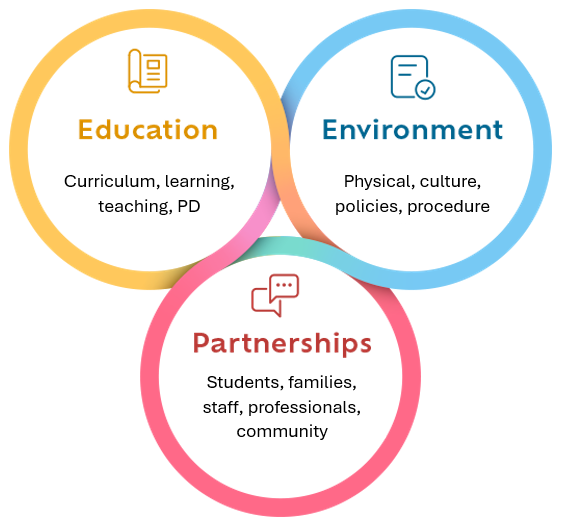
Health promoting schools
Background teacher note: Health promoting schools framework.
Partnerships
Environment
- Consider using suitable campaign material for promotion of healthy behaviours around the school or during events within the school that promote health - e.g. health expos. Note, this would need to be age-appropriate for all secondary school students.
Family
- Talk Soon. Talk Often: a guide for parents talking to their kids about sex is a free hardcopy resource that can be bulk ordered by schools and website. Send a copy home to parents prior to starting your RSE program. The booklet offers ages and stage related information on puberty (and other topics) so that parents can reinforce the topics covered in class. (How to order hard copies.) Provide the link to parents on school websites and social media.
- Run a parent workshop and run this activity with parents to model the content that will be covered in your RSE program.
- Run a parent and child evening session, where the children can teach the parents what they have been learning about.