
Learning objective

Students develop a repertoire of strategies to use to protect themselves from bullying. They also examine ways to help someone else that may be being bullied.

Take home messages

  • There are strategies we can use to protect self and others from being bullied.
  • To create a caring and safe school, we must let an adult or teacher know if we are being bullied or see someone being bullied.
  • Asking for help is not the same as 'dobbing' or 'telling'.

Materials

Student Activity Sheet: Ways to show self-respect and stand up for myself  [one per student]

Before you get started

Learning activities

Group agreement

5 min

Teaching tip: A group agreement must be established before any Relationships and Sexuality Education (RSE) program begins to ensure a safe learning environment. Read Essential Tool: Establishing a group agreement for tips on how to create one and what to include.

  1. Revise or create the class group agreement.

Whole Class

Students consider aspects of self-respect and identify ways to protect themselves from being bullied. 

  1. Explain that self-respect is when you value and accept yourself and believe that you should be treated well by others. If you have self-respect you are also careful to keep yourself safe.
  2. Conduct a circle talk strategy to ask the following questions. Ask the questions repeatedly so that students are exposed to a range of opinions:
    • How does someone who has self-respect behave?
    • How does someone with self-respect keep themselves safe if they receive a nasty text message or Facebook message?
    • How does someone with self-respect keep themselves safe if one person keeps telling them they can't join in their games?
    • Can you remind your partner what bullying is? (it's repeated unkindness to a person, not a single act of unkindness or just one argument)
    • Give each other some examples of bullying. (e.g. name calling; always leaving someone out of a game; using the phone or computer in a nasty way; embarrassing someone; physically hurting someone; hiding or breaking someone's possessions)
    • How do you think someone who is being bullied might feel? (highlight feelings such as anger, fear, helplessness, worry, nervousness, sadness)
    • Is it a person's fault if they are bullied? (no, it is always the fault of the person who bullies)
    • Why do some people get picked on more than others? (they may appear nervous so other children think they are easy to boss around; they may appear different, but this is not an excuse to bully someone; they may not stand up for themselves when they have been teased in the past)
    • What does someone look and sound like when they are being confident? (they stand tall, they look people in the eye, they talk with a loud voice in a friendly way, they don't use a baby or silly voice, they don't ignore it if someone is mean to them)
    • Why do you think acting confidently can protect you from being bullied? (you look like you have self-respect and might stand up for yourself if you are bullied so someone is less likely to be mean to you)
    • Why is asking a teacher for help what someone with self-respect would do if they couldn't stop someone from bullying them? (asking for support means you value and care for yourself and want to keep safe. Asking for help is not dobbing or getting someone into trouble)
  3. Conduct a brainstorm on What can you do to respect and stand up for yourself?
    • Ensure students consider strategies such as thinking for yourself, being positive, trying to stay calm when you are feeling angry or nervous, showing respectful body language, listening to others, sharing and taking turns, being a good sport, saying no to things that you do not want to do, telling someone being mean to you (or others) to stop it in a confident voice, asking an adult for help if this doesn't work.

Independent or Small Group

Students consider actions to take if they see someone else being bullied and identify strategies to protect self and others from bullying.

  1. Discuss with students what they could do if they saw someone being bullied.
    • Show this person you know it's unfair.
    • Show the person who is bullying that you know it's unfair.
    • Tell the person who is bullying to stop.
    • Move away together or do something else with that person.
    • Ask a teacher for help if the bullying continues.
  2. Give each student the Student Activity Sheet: Ways to show self-respect and stand up for myself and have them complete it in pairs. Hear feedback and stress that the strategies they have identified might be different for different situations.

3-2-1 Reflection

Small Group

Optional Activity 

  1. Students work in pairs or groups of 3 to role-play scenarios from the activity sheet they just completed. 
  2. Students can take turns to practice responses. An additional third role of a bystander or a trusted adult can be included in scenarios. If students do not want to participate in the role play, they can observe and provide feedback for their peers. 

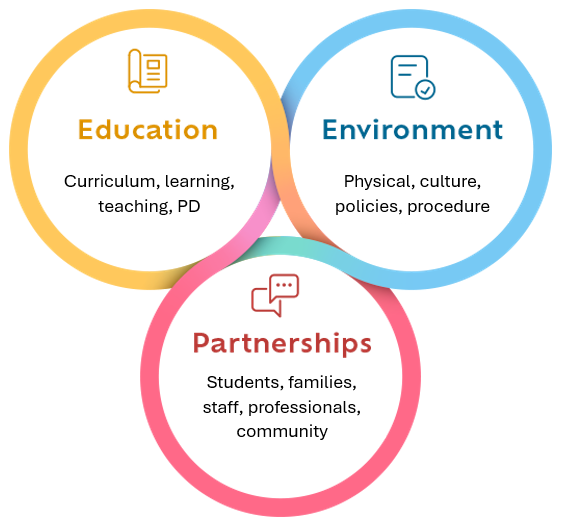
Health promoting schools

Background teacher note: Health promoting schools framework.

Partnerships

Family 

  • Talk Soon. Talk Often: a guide for parents talking to their kids about sex is a free hardcopy resource that can be bulk ordered by schools and website. Send a copy home to parents prior to starting your RSE program. The booklet offers ages and stage related information on puberty (and other topics) so that parents can reinforce the topics covered in class. (How to order hard copies.) Provide the link to parents on school websites and social media.
  • Run a parent workshop and run this activity with parents to model the content that will be covered in your RSE program.
  • Run a parent and child evening session, where the children can teach the parents what they have been learning about.

Environment

  • Students develop a poster or a class set of big picture books for younger students to inform them of ways to show respect and stand up for themselves. Encourage them to use the information from the brainstorm and the student activity sheet as quotes for their poster

Have a question?

Email the GDHR Team at gdhr@health.wa.gov.au

Contact Us